


For some time, our social and economic structures have rested on a straightforward assumption: cognitive processing is a scarce resource. That assumption is now being challenged. If highly capable cognition becomes abundant enough to be accessed at near-zero marginal cost, intelligence begins to look less like a personal differentiator and more like infrastructure.
To be clear, the frontier may remain concentrated. As Satya Nadella argued in A Frontier Without an Ecosystem Is Not Stable, the most powerful models could behave less like a public utility and more like scarce capital, controlled by a small number of organizations. Even so, much of the economy is already experiencing a sharp decline in the cost of generating standard cognitive output. Strategies, software, and analyses can now be produced in seconds.
When the cost of generating these outputs falls, economic value migrates toward whatever remains difficult to replicate.
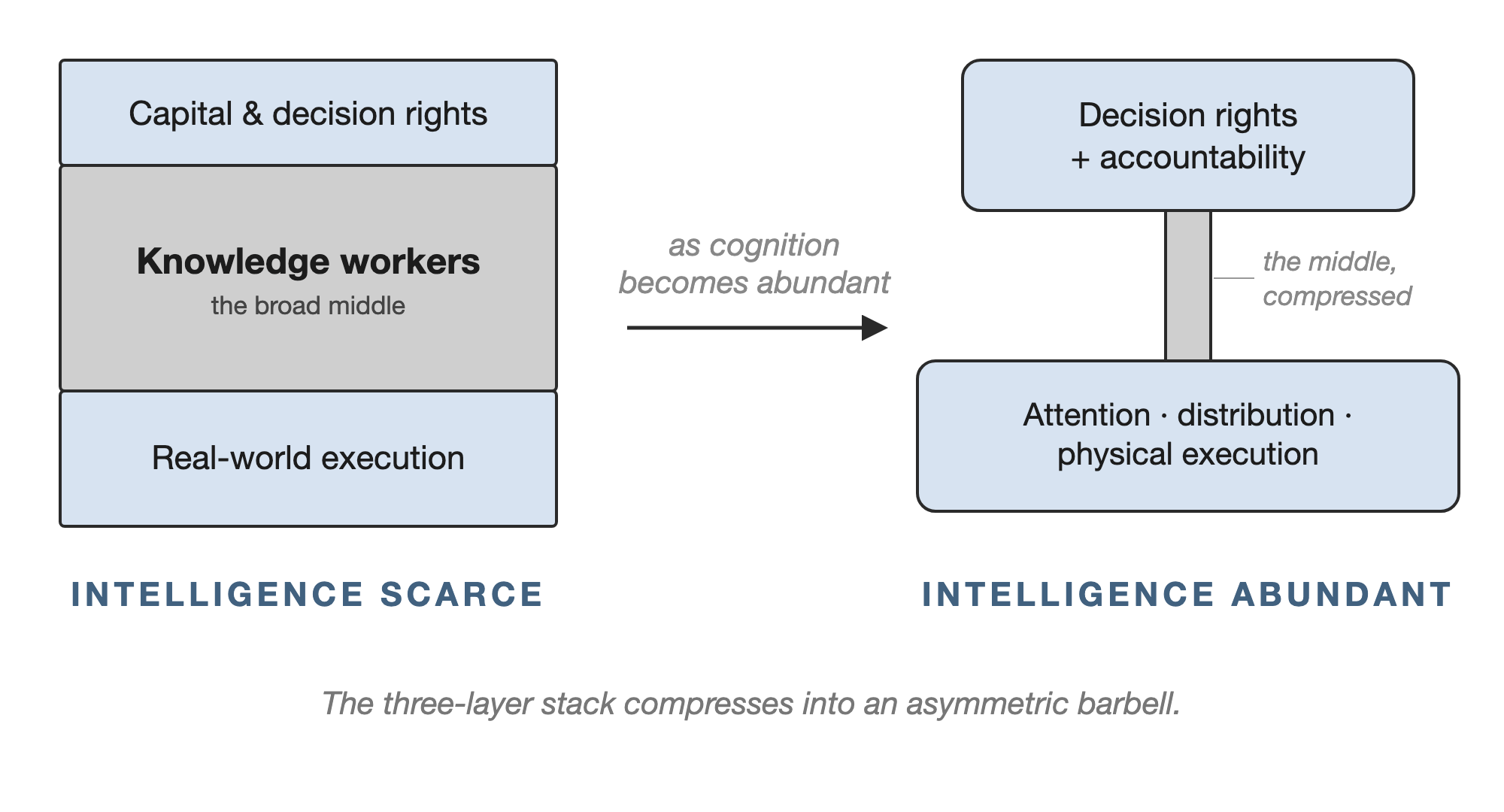
Historically, value creation resembled a three-layer stack: capital and decision rights at the top, real-world execution at the bottom, and a large middle class of knowledge workers in between whose role was to process information and translate a messy reality into structured choices. Intelligence scarcity made this middle layer uniquely defensible.
If cognition becomes abundant, that stack compresses into an asymmetric barbell. The middle layer faces increasing pressure, while scarcity accumulates at two extremes: decision rights and accountability at one end, and the friction of attention, distribution, and physical reality at the other.
I. Choice, Accountability, and Reflexive Systems
As the cost of automated analysis falls, decision-makers increasingly find themselves in direct contact with information and recommendations. Yet generating an option is fundamentally different from making a choice.
An artificial system can evaluate immense context and recommend a course of action with high statistical confidence. But many important domains like markets, politics, and corporate strategy are reflexive systems. Predictions influence behavior, behavior alters outcomes, and the future shifts in response to expectations about itself.
In such environments, uncertainty cannot be fully eliminated. Eventually, resources must be committed and consequences must be accepted.
Accountability derives its value from this reality. When a strategic decision fails, responsibility is assigned to a person or institution rather than to a model. Trust emerges from the same mechanism. We trust founders, executives, and organizations because they have something to lose when they are wrong.
The obvious objection is that decision-making is already automated: algorithms set prices, allocate capital, and increasingly act rather than advise. But a model that chooses still cannot be held to account, because it has nothing to lose. Responsibility settles on the principal that deployed it, and where uncertainty cannot be insured away, the willingness to own that consequence is what remains valuable.
The premium at the top of the barbell increasingly belongs to those who possess both decision rights and responsibility for the outcome.
II. The Lost Regeneration Engine
The standard response to technological disruption is historical optimism.
Agricultural mechanization displaced farm labor. Industrialization displaced manual labor. Computers automated clerical work. Each transition eliminated existing jobs but eventually created new categories of employment.
This observation is correct, but it rests on an important assumption: previous technological revolutions automated labor while preserving cognition as a scarce resource.
Workers could move up the value chain because human intelligence remained difficult to replicate. AI may be the first technological revolution that attacks the very mechanism through which the middle class historically regenerated itself.
Early signs of this pressure are beginning to appear in organizational design. In a memo accompanying workforce reductions at Block, Jack Dorsey argued that advances in intelligence tools, combined with smaller and flatter teams, were enabling a fundamentally different way of building and running companies. The significance of the statement is not the layoff itself. Organizations have restructured throughout history. What is notable is the underlying premise: that increasing cognitive leverage may reduce the need for organizational layers that previously existed to coordinate, synthesize, and transmit information.
Whether this model becomes widespread remains uncertain. What makes it interesting is that it does not merely automate tasks; it changes the economic rationale for the layers that sit between decision-makers and execution.
When an automated system can draft legal documents, write software, analyze financial statements, or create operational plans, the immediate response is that humans will move into verification. Machines will generate; people will review.
The difficulty is that verification is itself a cognitive activity. As verification becomes valuable, it too becomes a target for automation. The pattern becomes recursive. Machines generate. Humans verify. Machines learn to verify.
That sequence does not eliminate the middle. New professions will emerge, just as they always have. The difference is that each newly created cognitive niche is immediately exposed to the same force that displaced the previous one.
The argument is not that new forms of work will cease to emerge. They almost certainly will. The question is whether those new forms of work remain defensible long enough to absorb displaced labor at scale. Previous technological transitions benefited from a protected refuge: human cognition itself. The current transition appears to place that refuge under pressure. The result is persistent compression rather than disappearance.
A smaller number of people command dramatically greater leverage. Many routine forms of cognitive work become harder to defend. The middle survives, but it may no longer regenerate quickly enough to absorb displacement at the pace previous technological revolutions allowed.
This possibility may prove to be the key question of the AI era. Will the traditional mechanism that created new cognitive work continue to operate when cognition itself is no longer scarce?
III. The Real-World Friction of the Edge
At the opposite end of the barbell, value is governed by a simple economic principle. Technological shifts often do not create value in the newly abundant resource itself. Value resides in systems complementing the abundant resource.
If cognitive output becomes cheap and ubiquitous, the scarce complements become attention, distribution, and physical execution.
In a market saturated with synthetic content and ideas, the challenge is no longer creation but selection. Taste is best understood here as a practical selection mechanism. When a model can generate a thousand plausible product concepts, someone must still decide which path deserves the commitment of time, capital, and attention.
Distribution functions as a structural moat for similar reasons. A durable brand, a trusted audience, or an embedded enterprise relationship sits directly on the path between abundance and attention. These assets are valuable mainly because they embody accumulated trust through their reach.
Not all forms of distribution are equally protected. The operational aspects of digital distribution may experience many of the same compressive forces affecting the middle layer. The more durable advantage lies not in operating distribution systems, but in owning the relationships, audiences, and trust networks that sit behind them.
Finally, intelligence encounters limits imposed by physics, institutions, and time. As Dario Amodei argues in Machines of Loving Grace, intelligence eventually encounters diminishing returns once it collides with the pace and friction of the external world. Biological timescales cannot be accelerated through analysis alone, and bureaucratic processes do not move faster simply because a plan is more elegant.
The development of mRNA vaccines during the COVID-19 pandemic offers a useful illustration. Scientific advances dramatically compressed the time required to design effective vaccines. Yet the pace of global impact was ultimately governed by manufacturing capacity, regulatory approvals, supply chains, distribution logistics, and public adoption. Intelligence accelerated discovery, but the bottlenecks that followed were largely physical, institutional, and social.
Value does not track human exceptionalism; it tracks scarcity.
The Relocation of Scarcity
The commoditization of intelligence does not eliminate scarcity. It changes its location.
Trust runs through the entire structure. It underpins accountability at the top, shapes which information survives the compression of the middle, and determines which channels of distribution command attention at the edge. It is less a destination for value than the mechanism that allows value to accumulate elsewhere.
For much of the past century, the processing and brokerage of information occupied the center of economic life because those activities were expensive and rare. As those costs fall, the underlying bottlenecks of our systems become easier to see.
The question of our time is no longer who can generate the most intelligent answer. The more interesting question is where scarcity settles once answers become abundant.
If cognition becomes less scarce, the center of gravity of economic value may shift away from the layer primarily built around information processing and toward the layers responsible for accountability, distribution, and execution.
But a shift in where value accumulates is not the same as a reopening of room for the people it displaces. In earlier transitions the two moved together: the places that captured new value also needed hands, and the middle could follow them. What is uncertain now is whether that coupling still holds. The layers where scarcity is re-accumulating may hold great value for a few without making room for many.
A note on method: I used AI tools to pressure-test the argument, tighten the writing, and verify sources. The thesis and the judgment about what to keep are mine; which is, more or less, the division of labor this essay is about.
The thesis assumes that intelligence is becoming a commodity, but Gödel’s incompleteness theorem suggests that no sufficiently complex system can fully understand or verify itself from within. Intelligence is not merely the production of outputs; it includes the ability to transcend existing frameworks, redefine problems, and generate new abstractions. If AI mostly automates cognition within existing systems, then what is becoming abundant is computation, not intelligence itself. Consequently, the middle layer may not disappear but continually regenerate around higher-order forms of judgment and meaning. Scarcity may not migrate permanently to accountability and execution; it may recursively reappear in new cognitive domains. Rather than a stable barbell, the economy may remain a moving hierarchy where each wave of automation creates new levels of scarce human insight.